Video credit: ehowbeauty
Rain boots should keep your feet dry. That’s the job.
But should they feel tight? Loose? Roomy? Should your heel move? Should you size up for socks? And what happens if your calves seem to have declared independence from every boot shaft you try?
Getting the right answer matters because a rain boot that fits badly can turn an ordinary wet-weather walk into a miserable slog. A boot that is too tight can pinch your toes and rub your legs, while one that is too loose can let your foot slide around with every step.
The sweet spot is surprisingly simple: rain boots should feel secure around the foot, leave comfortable room for your toes, and have enough space for the socks or clothing you actually plan to wear.
Current 2026 fit guidance also stresses something many shoppers forget: don’t judge a rain boot by your usual shoe size alone. Different brands and designs fit differently, and tall boots add another measurement to the equation—your calf.

Image credit: Amazon / HISEA size guide
Why Rain Boot Fit Matters More Than You Think
Rain boots are different from sneakers and lace-up shoes.
Many classic wellies have no laces, buckles or straps around the foot. Once your foot is inside, there isn’t much you can do to fine-tune the fit.
That makes getting the initial size right especially important.
A good fit should let you walk naturally without your toes hitting the front, your heel constantly lifting, or your foot sliding from side to side. The shaft should also feel comfortable around your calf without squeezing it.
In other words, you want your boot to behave like a good handshake: secure, comfortable and definitely not trying to crush you.
For a broader look at fit, see our guide on whether rain boots should be tight or loose.
Should Rain Boots Be Tight or Loose?
Neither extreme is ideal.
Your rain boots should be snug enough to keep your foot reasonably secure, but roomy enough to let your toes move and accommodate the socks you intend to wear.
That balance is particularly important because most traditional rubber rain boots don’t mold to the foot in the same way as soft leather shoes.
Signs Your Rain Boots Are Too Tight
- Your toes feel cramped or pressed against the front.
- The sides squeeze your foot.
- Your instep feels compressed.
- The calf opening feels restrictive.
- You develop rubbing or pressure points quickly.
Signs Your Rain Boots Are Too Loose
- Your heel lifts dramatically with every step.
- Your foot slides forward on downhill walks.
- You feel like you’re walking inside the boots rather than with them.
- The shaft flops around your leg.
- You need multiple pairs of socks just to stop excessive movement.
Modern fit advice from retailers and boot makers consistently lands in the middle: secure foot hold, comfortable toe room and enough space for your intended socks. Kohl’s, for example, advises checking heel movement and calf opening when fitting rain boots, while current Merry People guidance recommends trying rain boots with the socks you normally wear outdoors.

Image credit: Hunter Boots
The 5-Step Rain Boot Fit Test
Ready to stop guessing your size?
Use this five-step method before buying—or before deciding that a pair you’ve already purchased is staying in the closet.
Step 1: Measure Both Feet
Don’t rely only on the number printed on your favorite sneakers.
Feet can differ slightly in length and width, and different manufacturers use different sizing systems. Measure both feet while standing, because your foot spreads slightly under body weight.
Place your heel against a wall, put your foot on a sheet of paper, mark the end of your longest toe, and measure the distance.
Then repeat on the other foot.
Use the larger foot measurement when selecting your size.
Also measure your foot width if the brand provides a width chart. A boot can have enough length and still feel painfully narrow.
Step 2: Measure Your Calves for Tall Rain Boots
This step is easy to skip—and that is exactly why it causes so many fitting disasters.
For tall rain boots, measure around the widest part of your calf while wearing the clothing you expect to wear with the boots.
Vionic recommends measuring the calf with a tape around the widest point and comparing that measurement with the brand’s calf-width guide.

Image credit: Vionic
If you regularly wear jeans tucked into boots, measure while wearing those jeans. Otherwise, your measurement may be technically accurate and practically useless.
For a more inclusive option, explore Jileon’s rain boot size guide, which covers calf, foot width and shoe-size measurements.
Step 3: Try Rain Boots On With Your Real Socks
This sounds obvious.
People still forget it.
Thin summer socks and thick winter socks can produce completely different fits.
If your boots are intended for cold weather, try them with the socks you’ll actually wear. Merry People specifically recommends trying rain boots with your usual outdoor socks and notes that thicker socks can change the overall feel.
Don’t make the mistake of testing a boot barefoot and then discovering in December that your “perfect fit” has mysteriously become a foot prison.
Image credit: Hunter Boots
Step 4: Test the Toe Box and Heel
Now walk around.
Don’t just stand there and admire yourself in the mirror.
Walk naturally. Turn. Bend your knees. Go up and down a few steps if you can do so safely.
Your toes should have room to wiggle, but you shouldn’t feel your foot sliding forward.
At the back, some heel lift can happen with pull-on rain boots because their construction is different from lace-up footwear. The problem is excessive movement.
Kohl’s current shoe-sizing guidance specifically notes that if your heel slams down while walking, the rain boots may be too large.
That is the difference between normal movement and sloppy fit.
Step 5: Check the Shaft, Calf and Ankle
Finally, focus on everything above the foot.
Can you move your ankle naturally?
Does the front of the boot crease painfully when you walk?
Does the calf opening press against your leg?
Can you comfortably tuck pants inside?
There should be enough room for normal movement without leaving a giant gap.
For wide calves, an adjustable or wide-calf design can make a much bigger difference than simply sizing up.
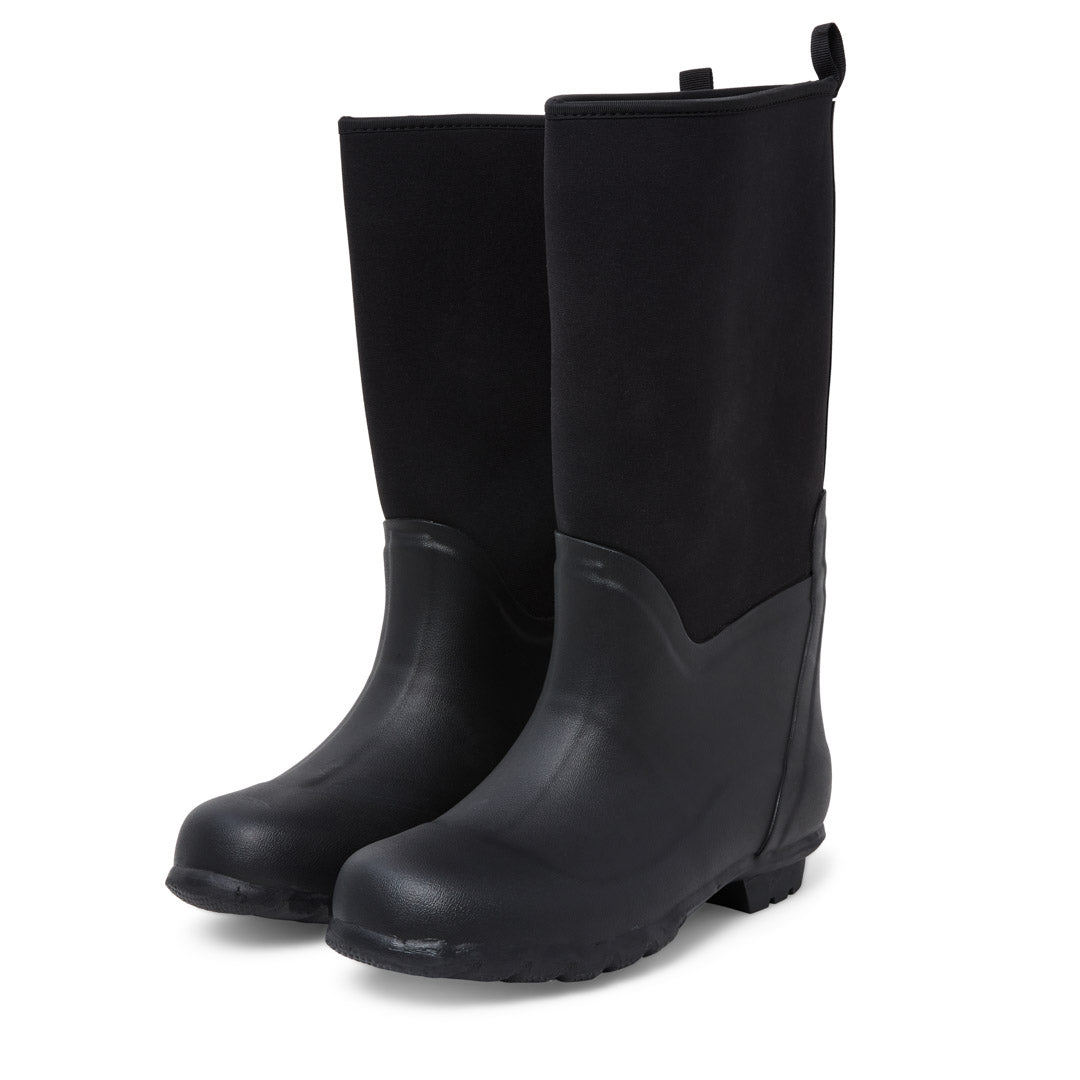
Image credit: Jileon RainBoots
How Much Toe Room Should Rain Boots Have?
You need enough space to move your toes naturally.
A commonly used footwear rule is roughly a thumb’s width of space in front of the longest toe, although the exact ideal amount varies with the boot shape, your foot and the way the manufacturer recommends sizing.
The bigger point is this: your toes should not touch the front when you’re walking.
Try leaning forward slightly or walking downhill. If your toes crash into the front of the boot, the boot may be too short—or the shape may simply be wrong for your foot.
A rounded toe design can be more forgiving than a narrow one.
How Much Heel Slip Is Normal in Rain Boots?
This is one of the most confusing parts of buying wellies.
A little heel movement can be normal, especially with pull-on boots.
But if your heel is lifting so dramatically that your foot feels unstable, you’ve probably gone too large or chosen the wrong shape.
Excessive movement also increases friction, which can lead to hot spots and blisters.
If you are between sizes, don’t automatically choose the larger size. Check the manufacturer’s size chart first and consider whether the issue is width, foot shape or sock thickness.
Should You Size Up in Rain Boots?
Sometimes—but not automatically.
This is where internet advice often gets a little too enthusiastic about the phrase “size up.”
Some brands recommend going up when you’re between sizes. Hunter’s current guidance, for example, says to size up when looking for a half size in its Original Short boots.
But Jileon takes a different approach for its own boots and recommends taking your normal shoe size or sizing down when between sizes.
That proves the point: brand-specific sizing matters.
Never assume that every rain boot follows the same sizing rule.
Read the individual manufacturer’s chart.
For another look at this question, see Should Rain Boots Be One Size Bigger?.
Do Rain Boots Need to Be Wider Than Your Regular Shoes?
Not necessarily.
But some rain boots have a different shape from your everyday shoes, and many people wear thicker socks with them.
If you have a wide forefoot, a boot that is long enough but narrow can still be uncomfortable.
Jileon’s current wide-fit models, for example, are specifically designed with wider footbeds and toe boxes in addition to larger calf measurements.
If your feet regularly need wide-width footwear, pay attention to the boot’s actual foot shape rather than simply buying a longer size.
A longer boot does not magically become wider.
What If You Have Wide Calves?
You are absolutely not alone.
Calf circumference is one of the biggest challenges with traditional tall rain boots.
Trying to solve the problem by going up several shoe sizes can create a second problem: now your boots fit your calves but your feet are swimming.
That is not a great trade.
Instead, look for:
- Wide-calf rain boots
- Adjustable gussets
- Stretch panels
- Neoprene shafts
- Shorter rain boot styles
Current Jileon models, for example, offer extra-wide calf options, while Merry People uses adjustable gussets on some mid-calf styles.
See Can Rain Boots Be Stretched? before trying any home modification. Stretching can sometimes make a minor difference, but it is not a magic cure for a fundamentally wrong size.
Can Rain Boots Be Too Loose Around the Calf?
Yes.
A little breathing room is useful.
A huge gap is not.
If the shaft is excessively loose, water can potentially enter from the top, especially during deep puddles or heavy rain.
Loose shafts can also move around while walking, which may become annoying over longer distances.
An adjustable boot can be a much better solution when your calf shape changes significantly along the leg.
How Should Short Rain Boots Fit?
Short rain boots are often easier to fit because calf circumference matters less.
That makes ankle-height styles a smart option for city commutes, errands and light rain.
Recent 2026 rain-boot testing also distinguishes between short boots for everyday use and tall boots for deeper puddles, muddy work and more extensive water exposure.
The guide to wearing rain boots over shoes covers another useful option when you want to protect regular footwear without carrying a second pair.

Image credit: Merry People
How Should Tall Rain Boots Fit?
Tall rain boots need to work at three levels:
- Foot: secure but comfortable.
- Ankle: enough room for natural movement.
- Calf: roomy enough for comfort and clothing without becoming floppy.
Hunter’s current Original Tall rain boot listing provides both shaft height and calf circumference information, which is exactly the kind of measurement shoppers should look for when buying tall boots online.
Image credit: Rouchette
What Socks Should You Wear With Rain Boots?
Socks can make or break the fit.
For mild weather, a normal moisture-managing sock may be enough.
For cold weather, thicker wool or boot socks can add warmth and fill some extra volume.
But don’t use socks to rescue a dramatically oversized boot.
If you need three pairs of socks just to stop your heel from moving, the boot probably isn’t right.
For a stylish example of boots paired with thick socks, Hunter’s current sock collection shows how much additional volume a proper boot sock can add around the shaft.
Image credit: Hunter Boots
Can You Wear Rain Boots Over Regular Shoes?
Sometimes.
Purpose-built overshoes and galoshes are designed for that job, while some roomy rain boots can accommodate lightweight footwear underneath.
The trade-off is bulk.
Your foot sits higher, the boot can feel heavier, and you may lose some natural movement.
For a quick commute or emergency downpour, that can be perfectly reasonable. For a long hike, it usually makes more sense to wear waterproof footwear designed for the activity.
See Do You Wear Rain Boots Over Shoes? for more details.
How Should Rain Boots Fit for Hiking?
For hiking, focus more heavily on foot security.
You do not want your foot sliding around inside a boot while walking downhill, climbing over uneven ground or navigating mud.
At the same time, don’t make the boot so tight that your toes are compressed.
For longer outdoor use, a waterproof hiking boot may provide better support and stability than a traditional flat rubber wellington.
Think about the terrain first and the boot style second.
How Should Rain Boots Fit for Gardening?
Gardening often requires a taller shaft because you’re moving through wet grass, soil and mud.
A roomy calf is useful if you wear work trousers.
A stable sole matters too because wet ground can become slippery very quickly.
Recent 2026 rain-boot testing continues to recommend taller, durable waterproof styles for gardening and other muddy outdoor work.
Image credit: Jileon RainBoots
What If Your Rain Boots Are Slightly Too Big?
A slightly roomy boot can sometimes be adjusted.
You can try a thicker sock, an appropriate insole or a heel grip, depending on where the extra space is.
The key word is slightly.
If your foot is sliding around dramatically, accessories are just papering over the problem.
Return or exchange the boots if possible.
That’s often far better than trying five internet hacks and ending up with a strangely shaped rubber boot.
What If Your Rain Boots Are Slightly Too Tight?
First, figure out where they’re tight.
Is it the toe box?
The width?
The instep?
The calf?
Different problems require different solutions.
Some natural-rubber boots soften somewhat with use, but you should not assume a dramatically undersized boot will stretch into the perfect fit.
Merry People’s current fit advice recommends wearing rain boots around the house before longer outings so the rubber can begin to soften and you can identify problems early.
For additional ideas, read Can Rain Boots Be Stretched?, but remember that returning an incorrect size is usually preferable to aggressive DIY stretching.
Common Rain Boot Fitting Mistakes
- Buying by size number alone: brand sizing varies.
- Ignoring calf circumference: especially with tall boots.
- Trying boots barefoot: your real socks matter.
- Buying extra-long instead of wider: length does not solve width problems.
- Ignoring heel movement: excessive slip can make walking uncomfortable.
- Choosing style over function: a beautiful boot that hurts is still a bad boot.
The water-resistant vs. waterproof footwear guide is also worth reading because choosing the correct level of weather protection matters just as much as getting the size right.
How to Test Rain Boots at Home
Don’t wait for a thunderstorm to discover your new boots pinch your ankles.
Try them indoors on a clean floor first.
Wear your usual socks.
Walk for several minutes.
Sit down.
Stand up.
Climb a few steps.
Flex your ankles.
Check whether your heel moves excessively.
Feel for pressure around the toes and instep.
And pay attention to something surprisingly important: how you feel after wearing them for 15–20 minutes.
A boot can feel wonderful for sixty seconds and annoying after ten minutes.
Rain Boot Fit Guide for Kids
Kids need a little room because their feet are growing, but “buy three sizes too big so they can use them for years” is not a good plan.
Oversized boots can be hard to walk in, especially for younger children.
Instead, follow the manufacturer’s kids’ sizing chart and allow reasonable room without creating excessive heel movement.
Hunter’s current children’s rain-boot sizing information, for example, provides detailed foot-length measurements and specific guidance for its models.
For more family-focused footwear advice, see Best Rain Boots for Kids.
How to Choose Between Ankle, Mid-Calf and Tall Rain Boots
Your ideal boot height depends on what you expect to encounter.
Ankle Rain Boots
Best for city walking, commuting and shallow puddles.
Mid-Calf Rain Boots
A useful middle ground for everyday rain and moderate outdoor use.
Tall Rain Boots
Best when you need more protection from deep puddles, mud, wet grass or outdoor work.
Recent 2026 rain-boot testing reaches a similar conclusion: short boots suit lighter urban use, while taller boots make more sense for gardening, muddy terrain and deeper water.
If you’re shopping specifically for winter conditions, see Best Boots for Snow and Rain.
How to Keep the Perfect Fit for Longer
Once you find a rain boot that fits, take care of it.
Wipe away mud after use.
Let the inside dry properly.
Store the boots upright.
Keep them away from excessive heat.
Don’t leave them baking beside a radiator like forgotten leftovers.
For a full care routine, read How to Clean Rain Boots.
Proper care helps preserve the boot’s shape, materials and overall performance.
Can You Wear Rain Boots All Day?
You can, but that doesn’t mean every rain boot is comfortable for all-day wear.
Traditional rubber boots can feel warm, stiff or heavy after several hours.
If you need all-day comfort, look for cushioning, a comfortable footbed, manageable weight and a shape that suits your foot.
Current 2026 reviews increasingly distinguish between boots for quick wet-weather errands and models intended for longer outdoor use.
The 10-Second Rain Boot Fit Checklist
Before you buy, ask yourself:
- Can my toes move freely?
- Does my heel stay reasonably secure?
- Does the boot pinch anywhere?
- Can I wear my normal rain-boot socks?
- Does the calf opening fit comfortably?
- Can I bend my ankle naturally?
- Does the sole feel stable?
- Does the size chart match my measurements?
- Does this boot suit the amount of water and mud I’ll actually face?
- Can I comfortably walk in it for 15–20 minutes?
Final Verdict: How Should Rain Boots Fit?
The perfect rain boot fit isn’t complicated once you stop thinking only about shoe size.
Your rain boots should be secure around the foot, comfortable around the toes, stable at the heel, and roomy enough for your normal socks. Tall boots add another important measurement: calf circumference.
Don’t automatically size up.
Don’t automatically size down.
Don’t buy a giant boot just because you have a wide calf.
And definitely don’t assume that a size 8 in one brand fits exactly like a size 8 in another.
Measure both feet.
Measure your calves if needed.
Try boots with the socks you actually wear.
Walk around.
Check toe space and heel movement.
Then think about how you’ll use them.
A lightweight ankle boot may be perfect for a rainy commute. A tall boot may be much better for gardening or muddy trails. And an adjustable wide-calf design can save you from the classic experience of getting your foot into the boot only to discover that your calf has been firmly rejected at the door.
The goal is simple:
Dry feet, comfortable steps, secure movement and no awkward waddling.
Because rain is already annoying enough.
Your boots don’t need to join the argument.